AI visibility questions, answered — including the ones it could not measure
AI-search tools hand you a visibility score. nqzai answers 23 of the questions a GEO/AEO lead actually gets asked with a decision, the evidence behind it, and an explicit list of what it could not test.
- 23 questions, each answered with a decision — keep, change or stop — not a score to interpret.
- Every answer names what it ruled out and what it could not test, with the reading that would settle each one.
- No provider data is bought. Answers read measurements already on file: ~40k tokens (~$0.080) each.
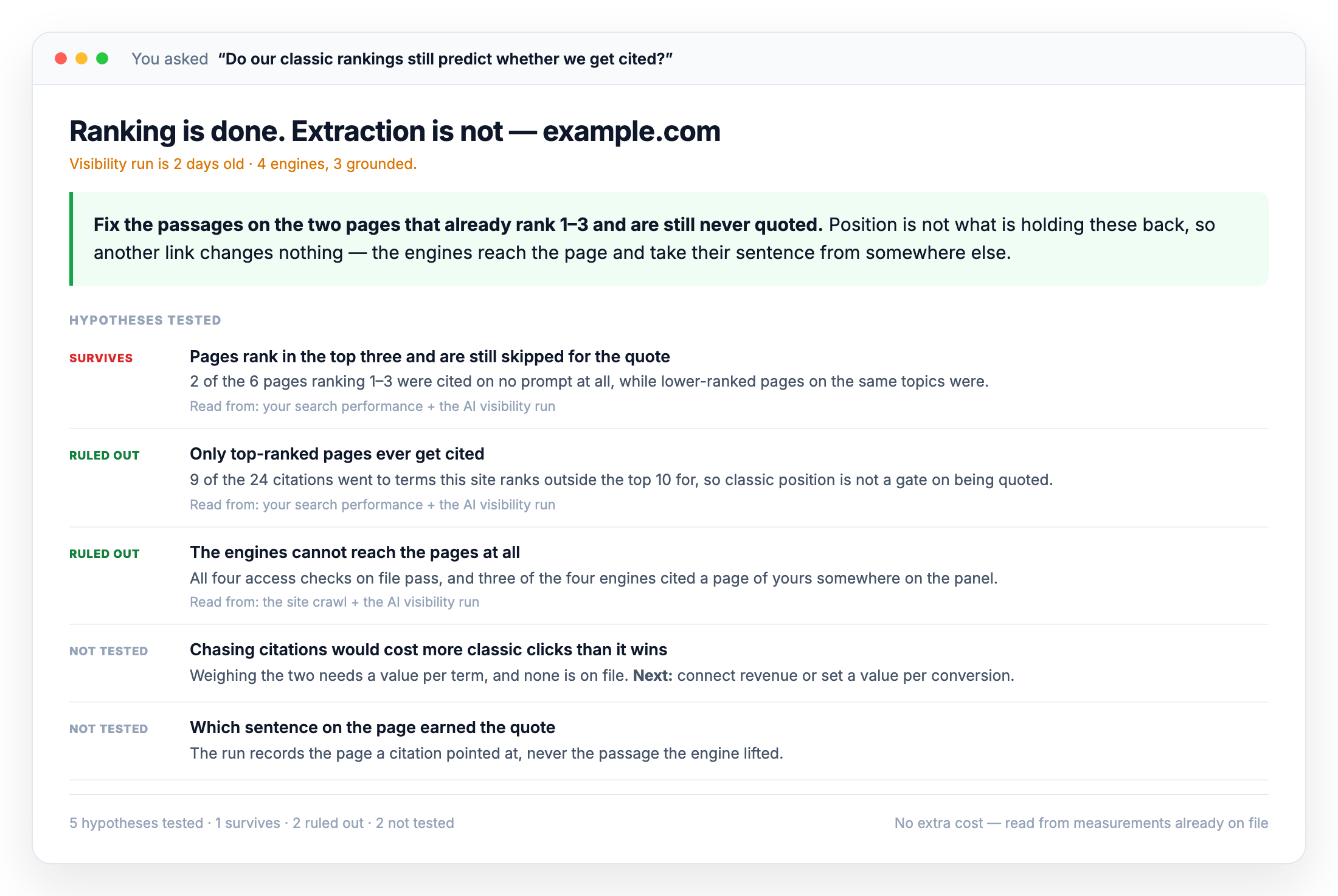
One question in, one page out: the decision first, the reasoning under it.
Start with the outcome
Get a decision on any of the 23 questions an AI-search lead actually gets asked
Direct answer: nqzai reads the visibility runs and search readings already on file for your site, tests the rival explanations against them, and returns keep / change / stop with the evidence named.
Ask nqzai in plain language. It selects the relevant workflow and shows the planned work before it runs.
“Do our classic rankings still predict whether we get cited?”What these answer, and what a score cannot
A visibility score returns a number whether or not it could verify its inputs. That is the failure these are built against: on a live run this week, one answer found that 75% of the sources engines had cited were domains it could not classify — and said so, rather than reporting a confident share of the quarter it did understand.
This is the practical layer between an AI search audit and an ongoing visibility report. We explain what GEO and Answer Engine Optimization (AEO) tools can establish, how to interpret AI search tools and visibility scores, and where a score is too thin to support a marketing decision.
Each of the 23 resolves to a decision with its reasoning underneath: the hypotheses that survived the evidence, the ones the evidence killed, and the ones nothing on file could test. The last group is the one no dashboard shows you.
What an answer looks like
Ask in the words you would use with a colleague. What comes back is a one-page brief with the decision at the top, because that is the part you needed. Under it: each hypothesis, what the evidence said about it, and which readings that verdict rests on. Click through the four below — the last one is a refusal, which is a shape a score cannot produce.
Do our classic rankings still predict whether we get cited?
Fix the passages on the two pages that already rank 1–3 and are still never quoted — the ranking is done, the extraction is not.
Two things there are worth naming. Ruled out is a positive result: it saves you the sprint you were about to spend. Not tested is the one no dashboard shows — in a score, a check that came back clean and a check that never ran look exactly the same.
The 23 questions
These are the questions that come up when someone asks why the AI answer did not mention you. Each routes to its own analysis, with its own hypotheses and its own decision rule.
Are we in the answer at all?
The measurement questions — where the first job is separating "not cited" from "never asked".
- Is it technically possible to track whether ChatGPT or Perplexity mention us?
- Why do some engines cite us and others ignore us entirely?
- Do our classic rankings still predict whether we get cited?
- Do engines quote us, or the people who quoted us?
- Do reviews, forums and local citations change whether AI recommends us?
- How do Wikipedia and Wikidata affect whether engines cite us?
What is answering instead of us?
When something of yours could have answered and did not, these say what took its place.
- Is our documentation answering, or our marketing?
- Which passages can an engine actually quote from our pages?
- How do we win "best X" prompts without becoming a listicle farm?
- What do we do when a model gets our brand wrong?
How should we write and publish?
The structure and publishing decisions, each with the rule that says no as well as the ones that say yes.
- How does query fan-out change how we structure long-form content?
- How should we publish original data so engines cite it rather than a recap?
- What is the practical difference between ranking for keywords and being chosen in an answer?
How do we run the programme?
The resourcing and scope questions that get argued without evidence, answered with the questions that settle them.
- Should B2B and B2C have different AI-search playbooks?
- How do we measure success when AI answers and the click never happens?
- Does focusing on AI search cannibalise our traditional SEO programme?
- How do we attribute pipeline from AI exposure with no referrer?
- How should multi-market content be handled when citation follows language?
- Should we hire a specialist AI-search agency, or can our team adapt?
- What does an AI-search audit check that a technical SEO audit misses?
- What should our AI-search measurement contract contain?
- Should we publish llms.txt and allow AI crawlers?
- What happens to market share if rivals industrialise AI search before we do?
Why an answer sometimes refuses
Some of these questions are comparisons, and a comparison needs two measurements. Asked whether B2B and B2C should have different playbooks with only one prompt panel measured, the answer does not split that panel into “B2B-looking” and “B2C-looking” halves — that would compare two guesses about intent while wearing the clothes of a comparison between two audiences, and you would have no way to see the split was invented.
It says so instead, and names the two panels to create. The same applies where a rank band holds too few terms to quote a rate, or where the sources behind an answer are mostly domains nothing recognises.
Where the hours actually go
Your tools report. The hour afterwards is the job.
Each row is a fact an AI-visibility tool already gives you, next to the question you actually had to answer with it — and what nqzai returns instead.
The report is still produced and saved — it rides along as the evidence for the answer, instead of being handed over in place of one. You can open it, copy it, or push it to your CMS. You just don’t have to read it to find out what changed.
Against the tools you already pay for
This is not a replacement for measurement. Keep the tracker — nqzai reads what a visibility run and your first-party accounts already produce. The column that matters is the last one.
| Tool | What it gives you | Price | Says what it could not measure? |
|---|---|---|---|
| nqzai AI visibility answers | 23 questions, each answered with a keep/change/stop decision, the evidence, and what could not be tested | ~40k tokens (~$0.080) per answer; no provider data bought | Yes |
| AI visibility scores and trackers | A visibility or share-of-voice number, usually blended across engines | Subscription, commonly custom-quoted | No |
| Manual prompt logging | Whatever you remember to ask, when you remember to ask it | Your time | No |
| Classic rank trackers | Positions in classic search results | Subscription | Not applicable |
Competitor pricing is commonly custom-quoted rather than published; where that is the case it is stated rather than estimated.
What this will not do
Worth stating plainly, because a claim without limits is a claim you cannot check.
- It will not invent a measurement. Where the reading is missing, the answer says which one and stops.
- It will not tell you what a model was thinking. The panel records which pages were quoted, never which sentence earned the quote, so the answers do not claim to explain why.
- It will not price a trade-off it has no values for. Weighing citations against classic clicks needs a value per term; without one that question stays open rather than being argued from what is available.
- It is not a ranking tool. Classic positions are read where they help answer a question about citations; measuring rank is a different job.
Ask one and see
Type the question the way you would say it. Each answer reads what is already on file for your account and buys no provider data.
~40k tokens (~$0.080) per answer, and every new account starts with 1 million tokens. Running a fresh measurement across the engines is a separate action, priced and approved before it runs.
Sign up and askFrequently asked questions
What is AI search visibility?
Whether an AI assistant names you, and cites one of your pages, when someone asks it a question your business should answer. It is different from ranking: an engine can read your page, answer from it, and never send the click — so being present in the answer is what gets measured, not the position.
How is this different from an AI visibility score?
A score compresses everything into one number and cannot tell you which of its inputs it failed to verify. These are 23 separate questions, each answered with a decision and an explicit list of what could not be tested. Where the evidence is thin the answer says so and names the reading that would settle it, instead of averaging the gap away.
Do the answers cost extra?
No provider data is bought. Each answer reads measurements already on file for your account and costs about ~40k tokens (~$0.080) of your balance for the reasoning itself. Running a fresh measurement across the engines is a separate, priced action you approve before it runs.
Why would an answer refuse to answer?
Because some questions are comparisons, and a comparison needs two measurements. "Should B2B differ from B2C" cannot be answered from one prompt panel — splitting one panel into B2B-looking and B2C-looking halves would compare two guesses about intent while looking like a comparison of two audiences. The answer says that, and names the two panels to create.
Which AI engines are covered?
ChatGPT, Gemini and Perplexity by default, with Claude available. Answers distinguish an engine that answered and did not cite you from one that returned nothing at all — a silent engine is not evidence that you are absent.
What do I need connected before these are useful?
A website, and for the questions that pair search behaviour against citations, Google Search Console. Several work from a visibility run alone. Each answer tells you which readings it used and which it wanted, so a thin account gets an honest map rather than a blank.
Can I see what an answer looks like before signing up?
The worked examples on this page are the real shape: a decision at the top, the hypotheses that survived and were ruled out beneath it, and the ones that could not be tested with the reading that would settle each. No customer data appears on this page.