AI Backlink Outreach Tool
Find Backlink Outreach Targets Worth Contacting
Enter a topic to prepare a focused search for credible outreach opportunities. Results are illustrative until you review and approve a planned run.

Illustrative result
What a backlink-outreach plan can prepare
- Guest-post opportunitiesRelevant sites to evaluate for an editorial pitch.
- Resource pagesCurated pages that may fit the topic.
- Available contactsContact details surfaced for review before outreach.
This is an example of the workflow shape, not a result from your input.
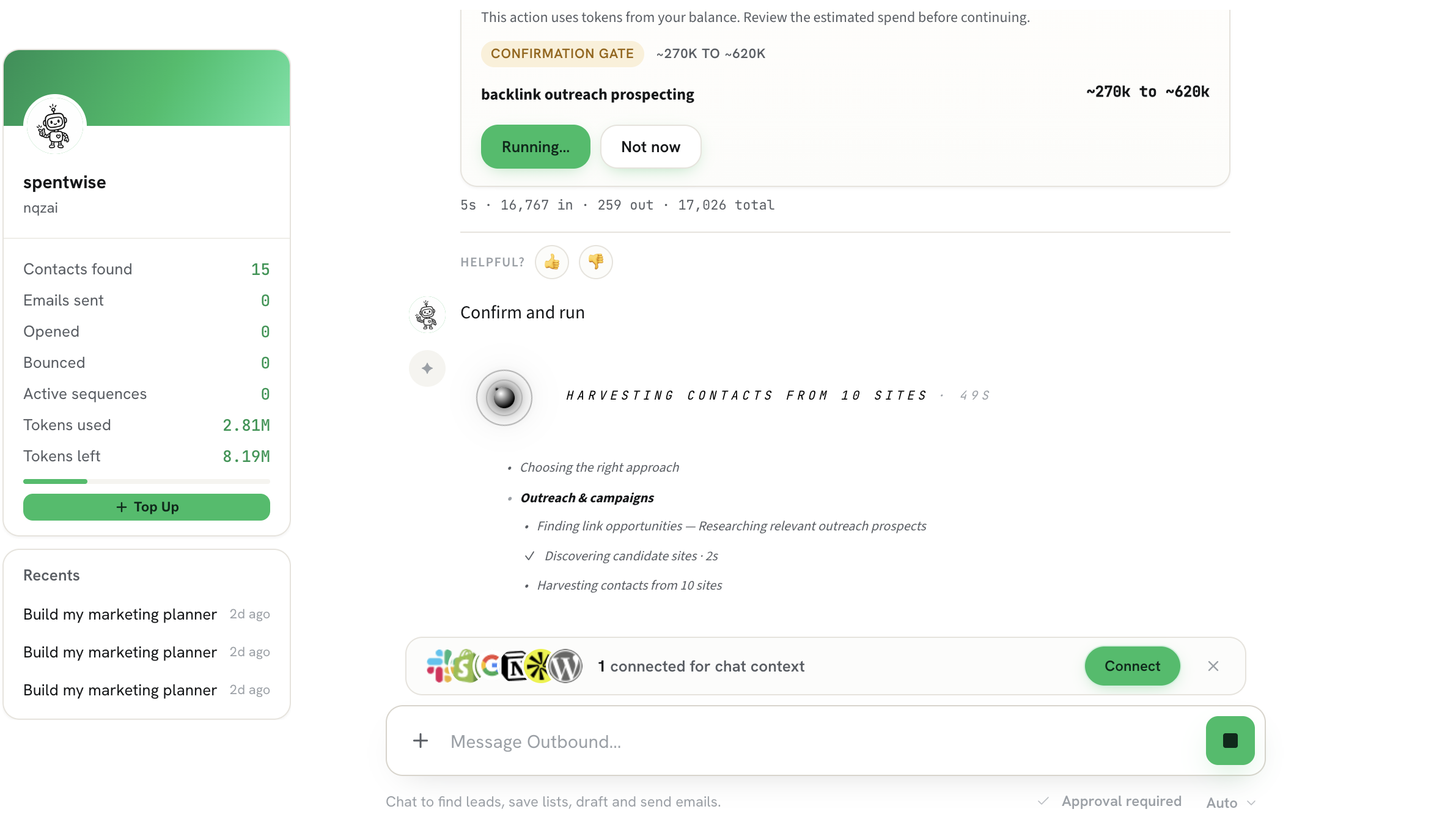
A real nqzai backlink outreach run — discovered targets, resolved contacts, one agent.
Start with the outcome
Find credible sites to approach for a backlink
Direct answer: nqzai researches relevant backlink opportunities, identifies available contacts, and prepares outreach without promising a placement or link.
Ask nqzai in plain language. It selects the relevant workflow and shows the planned work before it runs.
“Find backlink outreach targets for my cybersecurity site”What is an AI backlink outreach tool?
An AI backlink outreach tool automates the research side of manual link building: finding sites likely to link to you — guest-post opportunities, curated resource pages, niche directories — and finding a real person to contact at each one, instead of hand-searching "[topic] + guest post" and collecting emails one site at a time.
The category splits into two real mechanisms that get marketed as interchangeable but aren't: proactive discovery (search for guest-post/resource-page opportunities and reach out first) and reactive journalist matching (platforms like HARO/Connectively where journalists post requests and you respond as a source). nqzai does the first. It's worth knowing which one a tool actually does before comparing prices.
Outreach is also only half of link building. This page covers earning new links; the links you already have — what each one is worth, whether it is still live, and who really hosts it — are covered on the backlink checker page. The two meet at gap analysis: the referring domains linking to a competitor and not to you are, by definition, sites that already link in your category.
How nqzai finds backlink targets
- Give it a topic. "Find backlink outreach targets for AI agent governance" is enough.
- It searches for guest-post, resource-page, and directory intent around that topic — the same search patterns a manual link builder would run, automated and deduplicated.
- Your own domain is auto-excluded — resolved from your saved site settings, no need to re-type it.
- One bulk contact-harvest pass runs across the discovered domains, filtering out disposable and placeholder addresses before anything is saved.
- Targets and contacts save to a list — ready for the same agent to draft and send personalized outreach in the same conversation.
From target to sent pitch: automate backlink outreach in one agent
Discovery and outreach usually live in two different tools — a prospecting tool that hands you a spreadsheet, then a separate outreach tool (or your own inbox) to actually write and send the pitch. Because backlink targets land in the same contact-list system as any other nqzai outreach, the same conversation that found the targets can draft personalized pitches for them and send through your own connected email provider — no export, no second tool.
"Guaranteed backlinks"? What's actually true
Some tools in this category advertise a guaranteed number of DR 30+ placements per month with a money-back promise. That's a legitimate model when it's backed by a large managed pitching operation running hundreds of pitches — but it's a fundamentally different product than a self-serve discovery tool, and the guarantee is a meaningful part of what's being paid for.
No automated tool — nqzai included — controls whether a third-party site owner or editor actually links to you. What nqzai commits to instead: a real search for real opportunities, real resolved contacts, and an honest "found 0" report when a niche genuinely doesn't have viable targets, rather than a padded list that looks better than the run actually was.
Is this a HARO, Connectively, Featured.com, or SourceBottle alternative?
Not directly — different mechanism, not a drop-in replacement. HARO (now relaunched free under Featured.com), Connectively, and SourceBottle are all reactive: journalists post source requests, and you respond hoping to get quoted and linked. nqzai's backlink tool is proactive: it searches for guest-post and resource-page opportunities and reaches out first, rather than waiting for a matching request to appear.
How nqzai compares
| Tool | Discovery method | Guarantees backlinks? | Starting price |
|---|---|---|---|
| Backlinker.ai | Journalist-request platforms (Featured.com, HelpAB2BWriter, SourceBottle) — managed pitching | 3+ DR 30+ backlinks/mo guaranteed or money back | $300/mo (single Pro plan) |
| Pitchbox | Automated guest-post, resource-page & broken-link prospecting + personalization + follow-up sequences | No guarantee | From $165/mo (up to ~$210/mo annualized per some sources) |
| Respona | Integrated prospect search + automatic contact finding + AI personalization | No guarantee | From ~$95-99/mo |
| Postaga | AI prospect matching + automated outreach sequencing | No guarantee | From $84/mo |
| Ahrefs | Backlink database + competitor analysis — data only, no outreach automation | No guarantee | From $129/mo |
| Semrush | Backlink analytics + prospect prioritization by authority metrics | No guarantee | From $139.95/mo |
| nqzai | Guest-post/resource-page/directory SERP discovery + bulk contact harvest, self-excludes your domain | None claimed — honest zero-result reporting instead | Pay-as-you-go tokens, 1M free — ~635K tokens worst-case per run, no subscription |
Pricing current as of this page's publish date, sourced from each vendor's own pricing page and independent 2026 reviews. Pricing changes — verify current rates directly with each vendor before budgeting.
Reports tell you what happened. Ask nqzai why.
Prospecting tools return a list of domains and a contact each. Whether those are the right domains, and why your outreach is not converting, is left to you. Those are the two questions worth asking.
The report is still produced and saved — it rides along as the evidence for the answer, instead of being handed over in place of one. You can open it, copy it, or push it to your CMS. You just don’t have to read it to find out what changed.
Find real targets, not a padded list
One prompt discovers guest-post and resource-page opportunities for your topic, resolves real contacts, and saves them ready for outreach — no guaranteed-number gimmick, no export to a second tool.
Frequently asked questions
What is an AI backlink outreach tool?
A tool that automates the research side of manual link building: finding websites likely to link to you (guest-post opportunities, resource pages, curated directories in your niche), finding a real contact at each one, and helping you reach out — instead of manually Googling "[your topic] + guest post" and hand-collecting emails one site at a time.
How does nqzai find backlink targets?
Give it a topic and it runs a set of search queries built around guest-post, resource-page, and directory intent for that topic, discovers candidate sites, automatically excludes your own domain, then runs one bulk contact-harvest pass across the discovered domains — filtering out disposable and placeholder addresses — and saves the results into a contact list. From there, the same agent that found the targets can draft and send personalized outreach to that list, in the same conversation.
Does nqzai guarantee backlinks or DR 30+ links?
No, and it's worth being direct about why: whether a site links to you is that site's editorial decision, not something any automated tool — nqzai included — actually controls. Some competitors advertise a guaranteed number of DR 30+ placements per month; that's a real, valid business model when it's backed by a large managed pitching operation, but it's a different kind of product than a self-serve discovery tool, and the guarantee is doing a lot of the pricing work. What nqzai guarantees instead: real discovered targets from a live search, real contacts (not fabricated), and an honest zero-result report if a niche genuinely has none — never a padded list to make the run look more successful than it was.
Is nqzai a HARO or Connectively alternative?
Not directly — they solve different problems. HARO (now relaunched free under Featured.com) and Connectively are reactive: journalists post source requests, and you respond hoping to get quoted and linked. nqzai's backlink tool is proactive: it searches for guest-post and resource-page opportunities for your topic and reaches out first, rather than waiting for a matching journalist request to appear. Worth knowing if you're comparing: the journalist-platform landscape is genuinely fragmented in 2026 — independent research (BuzzStream) found the average overlap between any two journalist-request platforms is only about 17%, so even committing to HARO/Connectively alone misses most of what's out there.
Is nqzai a Featured.com, SourceBottle, or HelpAB2BWriter alternative?
Same answer as HARO/Connectively: those are all reporter-request platforms (reactive, source-responds-to-journalist), which is a different mechanism than nqzai's proactive guest-post/resource-page discovery. If reporter quotes specifically are the goal, a dedicated journalist-request platform is the right tool for that job — nqzai's backlink tool is aimed at the guest-post and resource-page side of link building instead.
Are the contacts nqzai finds verified?
They're filtered — disposable and obviously-fake placeholder addresses are dropped before anything gets saved — but this specific tool does not run every contact through a separate deliverability-verification pass the way some of nqzai's other lead-discovery tools do. Worth knowing plainly rather than overselling it: expect the normal outreach hygiene of any prospecting list, not a 100%-inbox-guaranteed dataset.
How much does AI backlink outreach cost with nqzai?
There's no separate subscription for it — it's priced in the same pay-as-you-go tokens as everything else, roughly 635,000 tokens worst-case for a full discovery-plus-contact-harvest run (a typical run costs meaningfully less; that figure is the ceiling nqzai's own balance check enforces, not a rounded guess). Every new account gets 1 million tokens free on signup, which covers a run outright.
Can nqzai draft and send the outreach emails automatically?
The discovery tool itself doesn't auto-draft — it finds targets, resolves contacts, and saves them to a list. From there, the same chat agent can draft personalized outreach for that list and send it through your own connected email provider, in the same conversation — it's a continuous flow inside one agent, not a separate step in a different tool.