

TL;DR
The expensive AI failure often is not a wrong answer — it is a correct one nobody wanted, or a confident sentence resting on nothing. Guardrails against both need to be built as code that runs deterministically over what actually executed, not as prompt instructions the model is trusted to follow: checks that confirm a request before spend happens, checks that mark claims the system could not verify, and a closing summary of what could not be checked.
The design principle throughout: guardrails should add information to a decision the user still makes, never block them outright, and the measure of success is whether the times a check fires are worth the user's attention.
The expensive failure isn't a wrong answer
Direct answer: Most writing about trustworthy AI is about stopping a model from saying something harmful. That matters, but it isn't where the real cost sits.
The expensive failure is an assistant that does exactly what you asked, correctly, and hands back something nobody wanted. It's invisible in every log: the request succeeded, the tool returned, the bill is real. A search can return a list of perfectly correct records that are all a poor fit for what the account actually sells — nothing technically failed, but the output was useless, and a single clarifying question up front would have caught it.
The second expensive failure is a confident sentence resting on nothing. An assistant that hedges everything is useless; one that hedges nothing is worse, because you can't tell which sentences it actually checked.
Both are trust problems, and neither is solved by asking a model to "behave better." Reliable AI honesty has to be engineered, not requested.
Rule one: if it matters, it is code, not a prompt
Direct answer: Instructions alone are a weak mechanism for anything that actually matters. A model told, in plain language, not to leak an internal note or repeat sensitive context can still do exactly that — rewording the instruction to be more explicit doesn't reliably fix it, because the model is complying with a suggestion, not enforcing a rule.
That's not primarily a story about model quality. It's a story about mechanism. Guardrails that hold up in practice — spend limits, send confirmations, output scanning — are the ones implemented as code that runs deterministically over what actually executed, not as instructions the model is trusted to follow. Rules written only as prompt instructions are the ones that tend to regress quietly over time, without anyone noticing until it's expensive.
So durable honesty and safety features shouldn't be prompt lines. They should be functions that inspect what actually happened, where the model doesn't get a vote.
It questions the job before it bills you
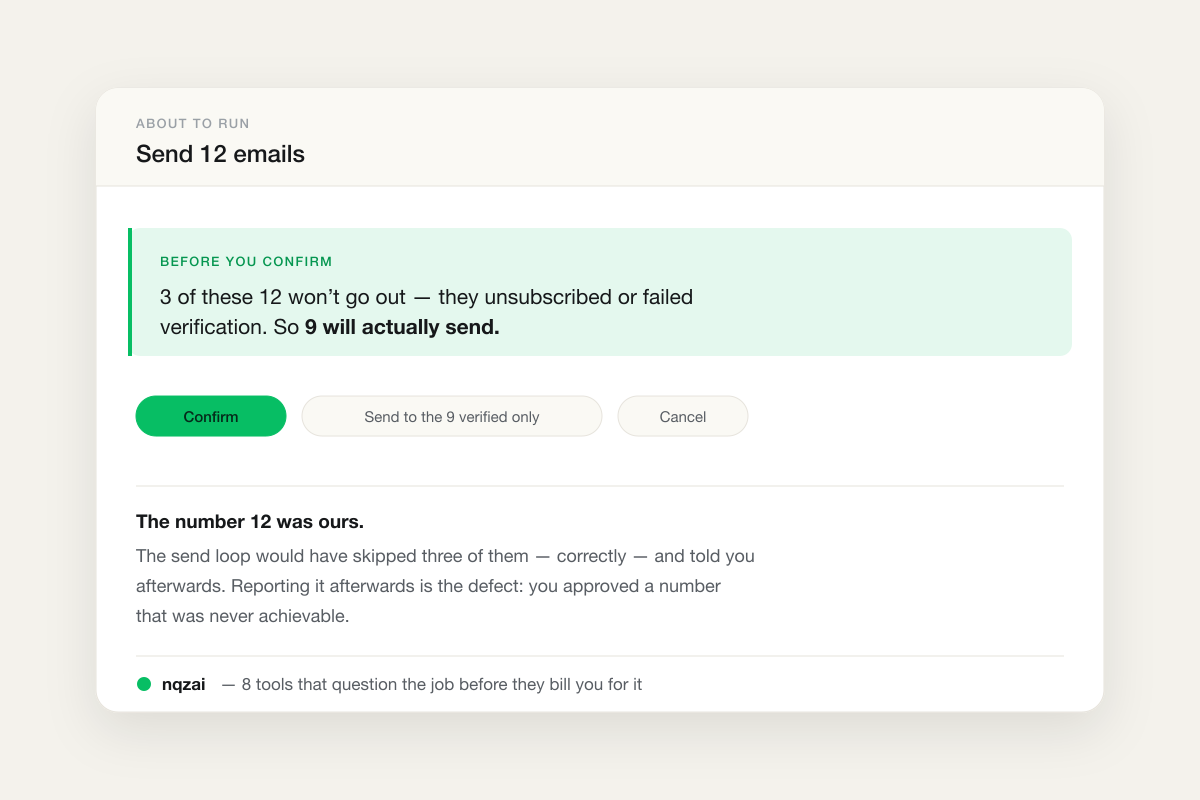
Direct answer: A well-designed guardrail layer checks a request before any spend happens, and surfaces that check as a plain-language line on the same approval step the user is already looking at — in front of the button it affects.
For example: a send-confirmation check can flag that some records in a batch won't actually go out (because they're unsubscribed or failed verification), and show the real, adjusted count before the user confirms — not after. Reporting a shortfall after the fact is the failure mode: the user approved a number that was never achievable.
Many of the most useful checks call no model at all — they're arithmetic over records already in hand: how fresh is this data, how many records carry a verdict, how large is the eligible set. This is a deliberate design choice. A model-based check that fires incorrectly argues with the user about their own data, and a user who gets argued with once learns to click past every warning afterward. Wherever a check can be made deterministic, it should be.
Not every proposed check earns a permanent place — some get built, evaluated, and removed because the cost of running them exceeds the value of what they protect. Recording that decision, rather than silently deleting the check, matters: "we tried this and it wasn't worth it" and "we never considered this" are different facts that look identical if nothing is written down.
It marks the claims it could not verify
Direct answer: When an assistant researches something live — searching the web, reading pages mid-answer — the honesty question is what it's then allowed to assert as fact.
A generated analysis can end up making a comparative claim about a page ("this page is less optimized than X") in one sentence, while a few lines later correctly noting that same page couldn't actually be read. Both claims can ship in the same message, and the caveat doesn't retract the assertion above it — readers tend to keep the specific, confident sentence and drop the general disclaimer, which is exactly backwards.
The fix is structural: track which pages were actually read, and mark any sentence describing a page that wasn't, directly in that sentence — something like (unverified — this page could not be read) — rather than relying on a general disclaimer elsewhere in the output.
A search result alone shouldn't count as having read a page. A search returns a title and a snippet, which supports "this page exists" but not "this page is better optimized" — collapsing that distinction is exactly the kind of gap that produces an overconfident claim.
It ends by saying what it could not check
Direct answer: A well-built research or analysis flow should close with a short, honest summary of what it couldn't verify: which page refused access, which search came back empty, and a note that anything depending on those gaps is unverified.
Two distinctions matter here. A site that blocks automated access is a permanent limitation on the analysis, not a transient error worth silently retrying, and the output should say so explicitly. And a search that ran successfully but returned zero results is still a gap worth reporting — a technically "successful" search with no results is not the same as an answer, and surfacing only hard failures would hide that more common case.
Ideally, this kind of footer is generated from the actual execution record rather than composed by the model on request, so it can't be skipped or forgotten in a rushed response.
It never blocks you
Direct answer: Guardrails built this way shouldn't be gatekeepers. Every check should add information — a warning line, maybe a suggested alternative — to a decision the user still makes; the confirm button should still mean "run it anyway."
This isn't just politeness. It's the user's budget and the user's market, and a system that overrules the user on either is worse than one that stays quiet. The measure of a guardrail layer isn't how often it fires — it's whether the times it fires were worth the user's attention.
What guardrails like this still cannot do
Direct answer: Verification claims generally only work when a claim names a specific, checkable target — a URL, a record, a domain. A vague sentence with no named subject can't be reliably attributed to any one source, and guessing at the target risks flagging correct statements as unverified. Named references are the common case in practice, since users typically supply the specific thing they want analyzed; unnamed or ambiguous references remain a harder, open problem.
Some sites will always refuse automated access, and that should be reported as a boundary rather than something the system tries to work around.
Coverage also isn't total — most guardrail systems only cover a defined set of checks, not every possible action. The rest should sit in an explicit, documented list of exceptions with a stated reason, rather than an unstated gap — because a silent omission and a considered decision look identical from the outside if nothing is written down.
Publishing that list honestly is more useful than claiming completeness. The same principle applies to the whole approach: a trustworthy AI product isn't the one that sounds most certain — it's the one whose uncertainty is visible.
Evidence and scope
Review date: 2026-09-04.
Reproducible use. Use the framework with a defined audience, source data, and review date; test material recommendations against your own evidence before making a production or buying decision.
Limit. This article is educational guidance, not legal, financial, security, or performance assurance.