The 30 SEO questions, answered with a decision
Every SEO tool you own can hand you a table. The hours go on turning those tables into "so what do we actually do on Monday?" nqzai answers that part.
- Ask any of the 30 questions in plain words. Each returns a keep / change / stop decision, not a summary.
- Each answer tests rival explanations and reports what it ruled out — the half that saves you a sprint.
- It states what it could not test, and what to connect to close it. No gap is filled with a guess.
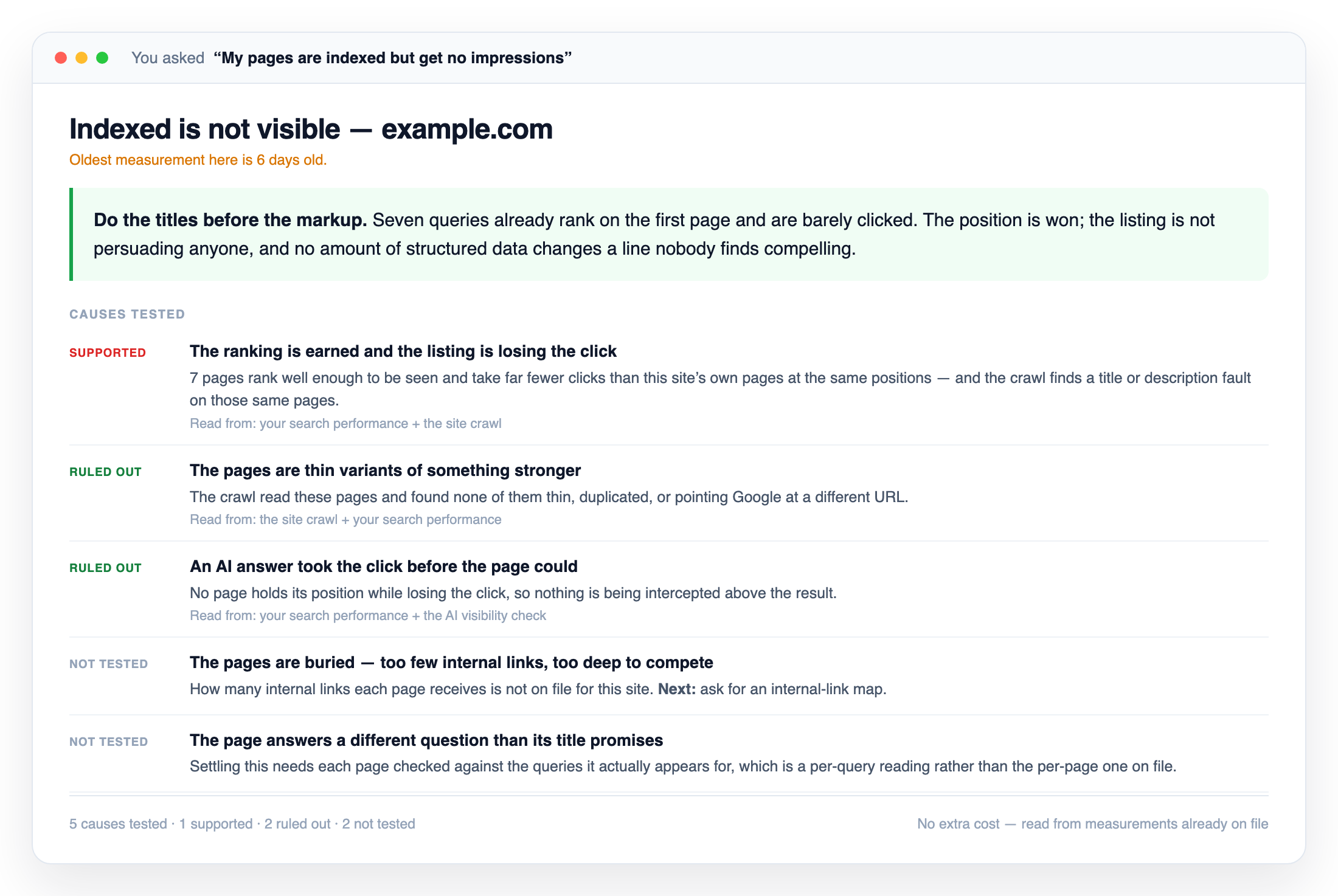
One question in, one page out: the decision first, the reasoning under it.
Start with the outcome
Get a decision on any of the 30 questions an SEO actually gets asked
Direct answer: nqzai reads the measurements already on file for your site, tests the rival explanations against them, and returns keep / change / stop with the evidence named.
Ask nqzai in plain language. It selects the relevant workflow and shows the planned work before it runs.
“Why is my organic traffic down?”Why another dashboard does not help
The data problem in SEO was solved years ago. Between a rank tracker, a crawler, Search Console and your analytics, almost every fact you need already exists somewhere in your stack. That is exactly why adding a fifth source changes nothing.
This is SEO analysis with the interpretation included: the framework connects traffic, crawl, indexation, and Search Console signals so you can decide what to fix first instead of adding another passive report.
What is still expensive is the part no tool does: holding four sources side by side, working out which explanation the numbers actually support, ruling out the ones they contradict, and noticing which question none of them can answer at all. That is judgment, it takes years to build, and it is the reason two people can look at the same dashboard and reach opposite conclusions.
What an answer looks like
Ask a question in the words you would use with a colleague. What comes back is a one-page brief with the decision at the top, because that is the part you needed. Under it: each rival explanation, what the evidence said about it, and which readings that verdict rests on. Click a category below to see the shape on a different question — it holds across all 30.
Why is my organic traffic down?
This is a tracking gap, not a ranking drop — fix the tag before anyone touches content.
Two things there are worth naming, because tools structurally cannot produce them. The first is Ruled out: a positive result that saves you the work. The second is Not tested, with the reading that would close it — because in a dashboard, a check that was never run and a check that came back clean look exactly the same.
The 30 questions
These are the questions that come up in a real SEO week — from a client, a founder, or the analytics tab at 9am on a Monday. Each one routes to its own analysis with its own rival explanations and its own decision rule.
Something changed
The questions that arrive as an emergency, where the first job is ruling out the panic.
- Why is my organic traffic down?
- How do we recover from a core update hit?
- How do we migrate the site without losing organic traffic?
- Are AI overviews taking our clicks?
What do I fix first
Prioritisation questions — the ones where a list of 400 issues is the problem, not the answer.
- How do we run a technical SEO audit and decide what to fix first?
- How healthy is the site for crawling and indexation?
- Which core web vitals failures actually matter for us?
- Is our crawl budget being wasted?
- What should our robots.txt and sitemap actually contain?
- How should we fix duplicate content and canonicals?
Content and keywords
Where to spend the writing budget, and what to stop writing.
- Which keywords should we actually target given intent and revenue?
- My pages are indexed but get no impressions — what is wrong?
- Should we prune or merge the underperforming content?
- How should we structure our topic clusters?
- This page ranks well but nobody converts.
- Does our content demonstrate E-E-A-T for this niche?
- Can we use AI to draft content and stay eligible?
- Which rich results can we win?
- Should we be doing video for SEO?
Competitors and links
Questions about other people’s sites, which is where confident guessing does the most damage.
- What is the competitive landscape and where can we realistically win?
- A competitor consistently outranks us — what gap can we close this quarter?
- Which backlinks should we earn, keep, or ignore?
Strategy and the people around you
The questions with no measurement to make at all, which get rules and trade-offs instead of a diagnosis.
- How long will SEO take and what will it cost?
- How will we measure SEO success and prove ROI?
- How should our SEO strategy change over the next few years?
- How do we work with developers so SEO recommendations actually ship?
- How do I explain this to a non-technical exec?
- How should SEO and paid search work together?
- How do we expand into other countries without cannibalising ourselves?
- How do we rank in cities where we have no office?
How the decision is reached
Each question carries a fixed set of rival explanations — the ones an experienced SEO would work through — and every one is tested against your stored measurements rather than argued from first principles.
- Two independent sources, or it is not a verdict. A cause can only be supported or ruled out when two genuinely different systems agree. A click-through rate and the position it was measured at are one system twice, and do not count.
- Ruling out is a result. If the evidence contradicts an explanation, that is reported as settled — not quietly dropped, which would leave you wondering whether it was checked.
- The gaps are named. Anything that could not be tested is listed with what would settle it, so the next step is a specific action rather than "get more data".
- No cause is invented to fill the page. If nothing survives, the brief says so and tells you which single reading would settle the most.
Where the hours actually go
Your tools report. The hour afterwards is the job.
Each row below is a fact one of your existing tools already gives you, next to the question you actually had to answer with it — and what nqzai returns instead.
The report is still produced and saved — it rides along as the evidence for the answer, instead of being handed over in place of one. You can open it, copy it, or push it to your CMS. You just don’t have to read it to find out what changed.
Against the tools you already pay for
This is not a replacement for measurement. Keep your crawler and your rank tracker — nqzai reads what they and your first-party accounts already produce. The column that matters is the last one.
| Tool | What it answers | Price | Decides what to do? |
|---|---|---|---|
| Rank tracker | Where you rank, and how that moved | Subscription, per tracked keyword | No |
| Site crawler | Which pages break a technical rule | Subscription, per crawled URL | No |
| Search Console | Queries, impressions, clicks, position | No charge, first-party | No |
| Analytics | What visitors did once they arrived | No charge, first-party | No |
| nqzai The only one here that commits to keep / change / stop, and the only one that tells you what it could not check. |
Which of the rival explanations the evidence supports, which it rules out, and which it could not test | No extra cost — reads measurements already on file | Yes |
Subscription pricing varies by vendor and plan tier and is not quoted here. nqzai's analysis carries no extra provider cost because it reads measurements already on file; anything that would buy fresh data is quoted to you before it runs.
What it will not do
Worth stating plainly, because a claim without limits is a claim you cannot check.
- It will not invent evidence. On a site with nothing connected, most causes come back untested — accurately. The answer is thin because the evidence is, and it says which.
- It will not write the page for you. "Do the titles first" is a decision; the titles are still yours to write.
- It does not replace experience. It removes the hours before the thinking starts and shows its reasoning, so the judgment can be checked rather than trusted.
- Some questions have no measurement at all. "How do we work with developers" gets rules and trade-offs, not a diagnosis dressed up as one.
Ask one and see
Type the question the way you would say it. The most common opener:
No extra cost for the analysis — it reads measurements already on file. Every new account starts with 1 million tokens.
Sign up and askFrequently asked questions
What does "answered with a decision" actually mean?
Every answer ends in keep, change, or stop — never a summary of the data above it. "Do the titles before the markup" is a decision. "Here are your 400 crawl issues, sorted by severity" is a list. The difference matters because the list is the part you were already able to get; deciding what to do about it is the hour you were spending afterwards.
How is this different from a rank tracker or a site crawler?
Those tools measure one thing each and measure it well — positions, crawl errors, sessions. None of them decides. You open three of them, hold the numbers side by side, and supply the judgment that turns them into a plan. nqzai reads the measurements already on file for your site and returns the plan, naming which readings it used.
What happens when there is not enough data to answer?
It says so, per cause, and names the reading that would settle it. A question with five rival explanations might come back with three ruled out and two untested — and the answer will tell you which three are settled, so you do not spend a sprint on them, and exactly what to connect or run to close the other two. An answer that cannot say what it failed to check is not an answer.
Why does it rule things OUT rather than just telling me the cause?
Because ruling something out is usually the more valuable half. Knowing that your titles, thin pages and AI answers are all clear means you stop spending time on them — that is a saved sprint, from evidence. Tools that only surface problems can never give you that, because a clean result looks identical to a check that was never run.
Do I need to connect anything first?
No, but coverage tracks connections. With Search Console connected and a site audit on file, most questions have something to test. With nothing connected, the answers are honest and thin: they tell you what would need to be read, which is itself a useful first plan. Nothing is invented to fill a gap.
What does it cost to ask one of these questions?
There is no extra cost for the analysis itself — it reads measurements already on file rather than buying new data, so no provider charge is incurred. You only pay the tokens the conversation itself uses, and every new account starts with 1 million tokens. Anything that would require buying fresh data is quoted to you before it runs, never after.
Is this a report I download, or a conversation?
A conversation. You ask the question in the words you would use with a colleague, and the answer comes back as a one-page brief: the decision, the causes it tested and what it found for each, and what it could not check. You can then argue with it, narrow it, or ask the next question against the same evidence.
Will it replace an SEO consultant?
It removes the hours a consultant spends assembling and reconciling data before they can think, and it will not invent experience it does not have. What it reliably does is get you to the decision point faster and show its work, so an experienced SEO can check the reasoning and a less experienced one can see why the recommendation follows from the evidence.