Competitor indexation checker
Find Your Competitor's Hidden SEO Secrets with Serpdex
Enter a public competitor domain to prepare an indexation audit of its visible Google footprint and sitemap coverage.

Illustrative result
What a public indexation review can help you investigate
- Sitemap coverageURLs to compare between the public sitemap and visible indexation.
- Indexation gapsPages that may need closer verification.
- Host consistencyRoot and www coverage to investigate.
This is an example of the workflow shape, not a result from your input.
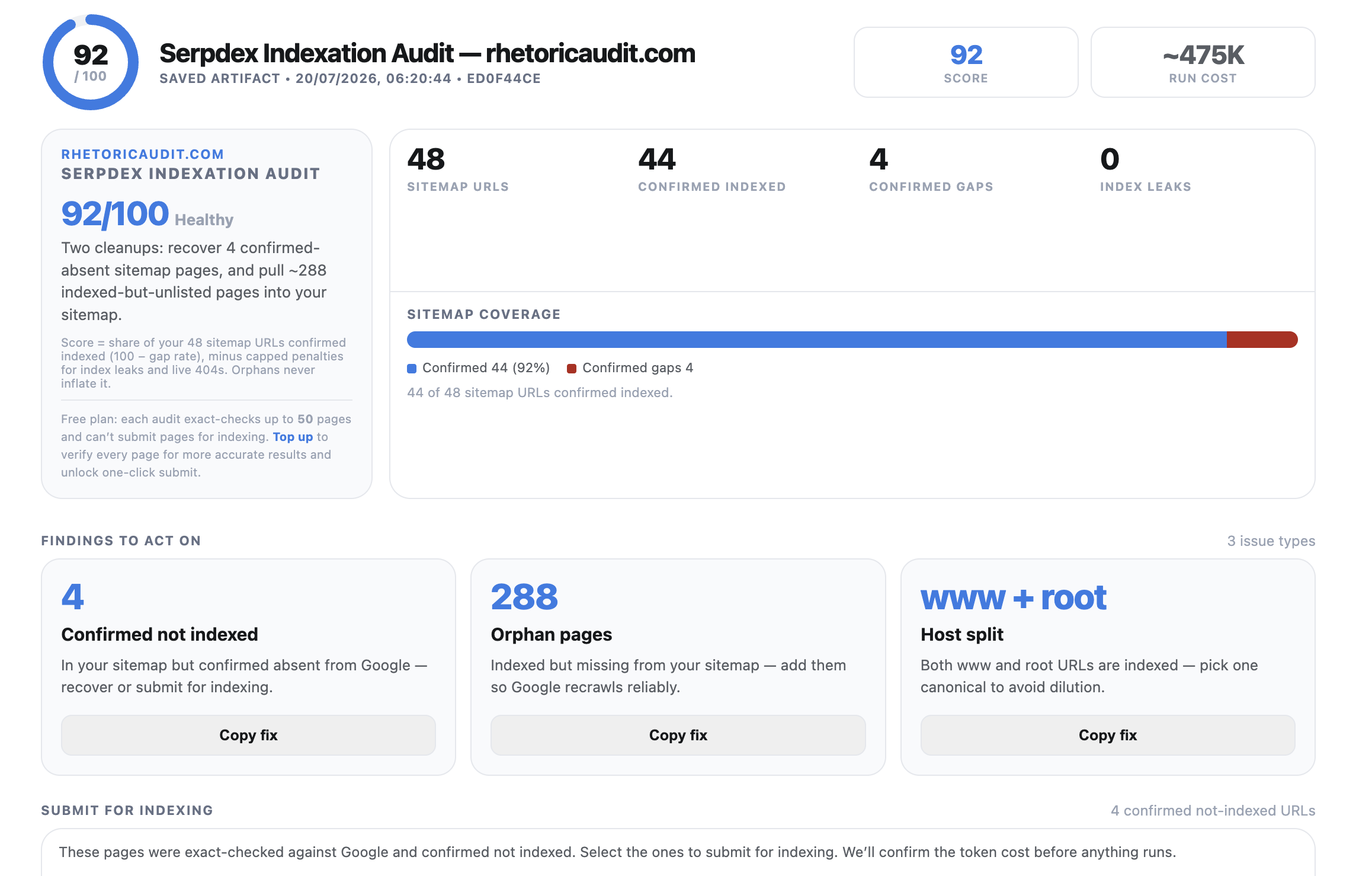
A real Serpdex audit — indexed vs. sitemap coverage, orphan pages, and canonical host issues for any domain, not just your own.
Start with the outcome
Find indexation gaps on any public competitor domain
Direct answer: nqzai compares a public domain’s sitemap with its visible index footprint to surface missing, orphaned, and canonicalization issues.
Ask nqzai in plain language. It selects the relevant workflow and shows the planned work before it runs.
“Run Serpdex on competitor.com”Why Google Search Console can't check a competitor's indexation
Search Console is built around ownership: to see any data for a domain, you first have to prove you control it — a DNS record, an HTML verification tag, or a linked Analytics property. That's the right design for protecting a site's own private search data, but it also means GSC is structurally incapable of ever showing you a competitor's indexation status, no matter how you configure it. There's no setting, no workaround, no "read-only" mode — verified-ownership is the whole security model.
That's the gap Serpdex is built to fill. It doesn't ask Google's private, owner-only API for data — it reads the same public search results anyone gets from a live site:example.com Google search, then reconciles that against the domain's public sitemap.xml and robots.txt. All three of those are already public information the moment a site goes live; nothing here requires the target's permission, login, or knowledge that you ran it.
Free GSC vs. manual search vs. competitive SEO suites vs. Serpdex
| Tool | Checks a competitor's indexation? | Starting price | Setup required |
|---|---|---|---|
| Google Search Console | No — owner-verified properties only | Free | Domain/DNS or HTML-tag verification required |
| Manual site: search | Yes — but no orphan detection, no sitemap diff, no history | Free | None, but entirely manual and Google truncates results |
| Ahrefs Site Audit | Crawls a competitor's pages, not Google's live index of them | From $129/mo | Full subscription + project setup |
| Screaming Frog | Crawls the site itself, not what Google indexed | Free (500 URLs) / £199/yr | Desktop install, manual crawl config |
| Serpdex (nqzai) | Yes — any public domain, live Google index vs. its own sitemap | Pay-as-you-go tokens (~813K tokens/audit), 1M free | None — one chat prompt |
Pricing reflects each vendor's published tiers as of 2026-07. Serpdex's own token cost is generated directly from nqzai's live pricing table, not a marketing estimate.
What a competitor's indexation actually reveals
- Orphan pages — content Google has indexed that never made it into the competitor's public sitemap. This is often the most interesting signal: an undocumented landing page, an old microsite still live, or a content section they've deliberately kept off their own navigation and sitemap but haven't actually removed from search.
- Confirmed indexation gaps — pages they clearly intended to rank (they're sitting right there in the sitemap) that Google never picked up. Usually points to thin or duplicate content, a canonical mistake pointing away from the page, or a crawl-budget problem on a site that's grown faster than its technical SEO.
- Canonical host inconsistency — a site indexed on both
www.and the bare root domain splits its own ranking authority in two. It's invisible from the outside unless you actually compare what Google indexed on each host, which is exactly what a Serpdex audit does automatically.
None of these are things a competitor would volunteer, and none of them show up in a generic site crawl (Screaming Frog, Ahrefs Site Audit) — those tools crawl the site itself, not what Google's index actually contains, which is a meaningfully different picture once a site is more than a year or two old.
How Serpdex avoids Google's own truncation problem
A plain manual site:domain.com search looks authoritative but isn't: Google's pagination silently truncates after roughly 40-150 results even when a site has thousands of pages indexed ("omitted results"), so eyeballing a manual search will make a genuinely well-indexed competitor look barely indexed at all. Serpdex treats Google's own reported total as the honest headline number, reconciles it against the full sitemap, and then exact-verifies every ambiguous URL individually — so a "gap" in the report is a real, confirmed gap, never a truncation artifact.
Reports tell you what happened. Ask nqzai why.
Competitive research usually means opening five different tools and stitching together a picture yourself. Serpdex is built so the picture is the answer, not homework you do after getting a document.
The report is still produced and saved — it rides along as the evidence for the answer, instead of being handed over in place of one. You can open it, copy it, or push it to your CMS. You just don’t have to read it to find out what changed.
Check any domain — yours or theirs — in one prompt
No Search Console connection, no ownership verification, no signup required from the site you're checking. Just name the domain.
Frequently asked questions
Can I check a competitor's Google indexation without their Search Console access?
Yes — that's the entire point of Serpdex. Google Search Console only reports on properties YOU own and have verified (via DNS, HTML tag, or Google Analytics link), so it structurally cannot show you a competitor's indexation. Serpdex reads live Google `site:` search results and cross-references them against the competitor's public sitemap.xml and robots.txt — none of which require any permission from the site owner, because it's all public information Google itself already serves to anyone.
What can I learn about a competitor's SEO from their indexation status?
Three concrete signals: (1) Orphan pages — content Google indexed that never made it into their public sitemap, often revealing an undocumented content strategy, a legacy microsite, or pages they'd rather you not find easily. (2) Confirmed indexation gaps — pages they clearly wanted indexed (they're in the sitemap) that Google never picked up, often a sign of thin content, canonical mistakes, or crawl-budget problems. (3) Canonical host inconsistency — www vs. root-domain indexation split, a technical-debt signal that quietly dilutes their ranking authority.
Is checking a competitor's indexation with Serpdex legal / against Google's terms?
Yes. Serpdex only reads information Google already publishes to anyone who runs the equivalent `site:example.com` search manually, plus a domain's own public sitemap.xml and robots.txt — the same files any browser or crawler can fetch. It never accesses a competitor's Search Console, analytics, or any private/authenticated system. There is nothing here a competitor's own SEO team couldn't see by running the same public searches themselves.
How is this different from a manual `site:domain.com` Google search?
A manual search shows you a truncated page of results with no structure — Google's own pagination cuts off at roughly 40-150 results even when a site has thousands of indexed pages ("omitted results"), so a manual scan alone will wrongly suggest a large site is barely indexed. Serpdex resolves that truncation properly: it treats Google's own reported total as the headline figure, then reconciles it against the full sitemap and exact-verifies the ambiguous URLs one by one, so gaps are gaps, not artifacts of Google hiding results from a bare search.
Do I need to verify ownership of the domain I want to audit?
No. That's the structural difference from every GSC-based tool: verification proves ownership, which is exactly what you don't have for a competitor, a prospect, or an acquisition target. Serpdex needs nothing from the target site's owner — just the domain name.
Can I run this on my own site too?
Yes — Serpdex works identically on your own domain, and for your own verified property nqzai also layers in a free check against Google's official URL Inspection API where available, so your own audits cost less than auditing a domain you don't control. Either way, one tool covers both "audit myself" and "audit them."
How much does it cost to audit a competitor with Serpdex?
A default crawl-only audit runs at roughly ~813K tokens — pay-as-you-go, no subscription, and new accounts start with 1M tokens free. There's no per-competitor contract or seat fee the way there is with most competitive-intelligence SEO suites; you pay only for the audits you actually run.
What other competitor research does nqzai offer besides indexation?
Indexation answers one question — whether a domain is hiding or orphaning pages. For overall visibility share or a keyword-gap list, see the competitor research hub, which covers all three as separate tools for separate questions.