Content Optimization Tools
Content Optimization Tools: Find Out Why Your Page Isn’t Ranking
Enter a public page URL to diagnose the technical, on-page, and search-intent gaps worth investigating first.

Illustrative result
What a page diagnosis can help you investigate
- Technical accessCrawlability and page signals to review.
- Content coverageGaps between the page and likely search intent.
- Next actionsA practical order for investigating improvements.
This is an example of the workflow shape, not a result from your input.
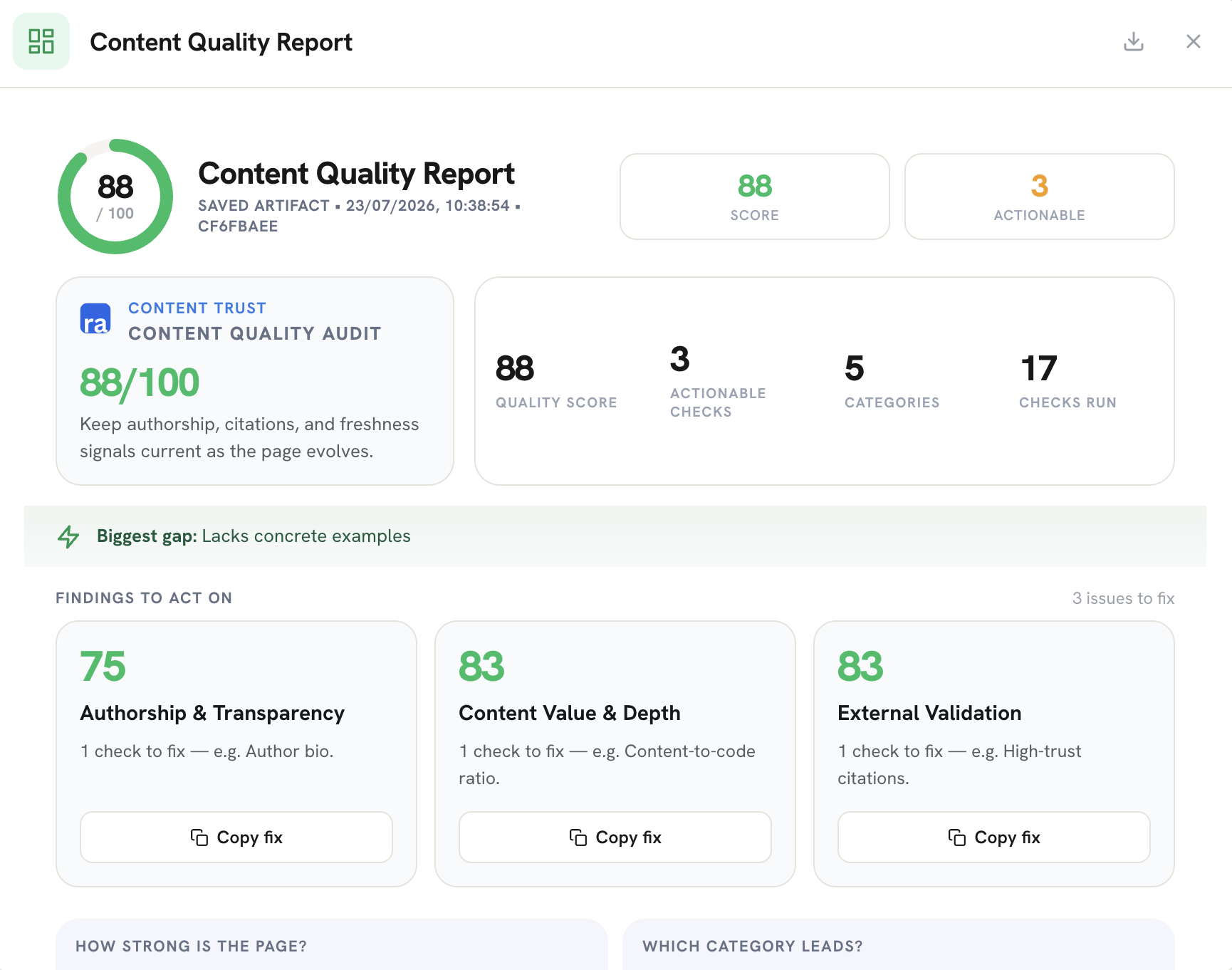
A real nqzai content quality check — E-E-A-T score across 5 categories, 17 checks, with copy-paste fixes.
Start with the outcome
Understand why a page is not earning visibility
Direct answer: nqzai evaluates a page’s depth, structure, and trust signals, then returns specific improvements rather than a generic content score.
Ask nqzai in plain language. It selects the relevant workflow and shows the planned work before it runs.
“Check my content quality”Which content optimization tool should you pick?
Direct answer: Pick Surfer SEO (from $49/mo) for real-time, SERP-based writing guidance with built-in AI tracking, Clearscope (from $129/mo) for editorial consistency across a large writing team, and Frase (from $49/mo) for fast briefs. On a tight budget, NeuronWriter starts at $23/mo. The table below compares all 15.
- You also need AI-search visibility tracking: Surfer SEO, Rankability and Writesonic (higher tiers) include it; Clearscope, Frase and MarketMuse do not.
- You work in WordPress: Yoast SEO and Rank Math both have a free version for on-page basics.
- You want a content quality and E-E-A-T check with the audit and the writing in one agent: that is what nqzai does.
AI-assisted content refresh workflow best practices
Direct answer: An AI-assisted refresh workflow detects what has decayed, triages it, refreshes the claim itself, re-verifies sources and re-baselines the page. Prioritize pages by value and staleness severity, not age. Our change-detection workflow lays out each step.
Content refresh best practices SEO 2024 Google Search Central
Direct answer: Refresh the substance, not the date: a bumped “last updated” field with no real change doesn't move citation behavior. Fix a high-traffic page with a broken source link first, and defer a minor date typo on a low-traffic page.
Content audit and refresh checklist HubSpot SEMrush 2023 2024
Direct answer: A refresh checklist covers claims that have aged out, sources that have moved or died, and shifted competitor facts. HubSpot's rolling refresh program is the best-documented case: 106% more organic visits and roughly double the leads from updated posts. SEMrush's SEO Writing Assistant, included in its Guru plan, adds in-editor checks while you draft.
How to use AI to refresh existing content workflow
Direct answer: Start from your own data, not a score. nqzai finds pages in striking distance using your Search Console data and ranks them by the traffic a small move would actually earn. It compares each page against what currently ranks for its target query and returns the structural gaps as edits. After the rewrite it compares impressions, position and clicks before and after, and says when the difference is too small to attribute.
AI content refresh workflow best practices
Direct answer: The best practices for an AI content refresh workflow are to watch claims, not just dates, and to run detection continuously, not annually. Tag time-sensitive claims with an expected shelf life, check outbound links on a schedule, and score each finding by page value and severity. Re-baseline after every refresh so the page re-enters monitoring.
Evaluate refreshed content performance over time
Direct answer: Evaluate a refresh by comparing impressions, position and clicks before and after the change, and by saying plainly when the difference is too small to attribute. Re-baseline the page after each refresh so it re-enters monitoring. HubSpot's rolling refresh program shows the payoff of tracking this over time: 106% more organic visits and roughly double the leads from updated posts.
AI methods to detect outdated content
Direct answer: Detect outdated content at the claim level, not the page-age level. Tag any sentence with a number, date, “currently” or “as of” with an expected shelf life when it is written, run scheduled outbound link-health crawls, and re-check source credibility. Add a competitive fact-watch for comparative claims. See the change-detection workflow.
Best practices content management tracking accessibility
Direct answer: Manage content with assigned roles, scheduled reviews and update triggers, because governance has no endpoint after publishing. For accessibility tracking, define the audit scope, a review frequency and named owners, and prioritize high-traffic pages. WCAG 2.1 AA is generally recommended as the target level. See the accessible content audit checklist and content governance.
Standard security pack vendor review contents
Direct answer: A standard security pack for vendor review holds a SOC 2 Type II report or bridge letter, an ISO/IEC 27001 certificate with its Statement of Applicability, a penetration test attestation or redacted summary, a data flow diagram, a subprocessor list and a DPA. Many buyers also ask for an architecture overview, an incident response plan summary and a CAIQ response. See the security review content kit.
What is SEO content optimization software?
An AI content optimization platform — sometimes just called AI content optimization software — analyzes the pages already ranking for a target keyword and tells you what a competitive page needs — related keywords and entities, a target word count range, heading structure, and usually the "People Also Ask" questions worth answering. Some tools stop at scoring a human-written draft; others generate the draft too; a growing number add AI-search visibility tracking on top, since the same structural signals that win rankings now drive AI citations.
A content optimizer turns that analysis into practical edits: it helps prioritize missing coverage, weak headings, unclear answers, and evidence gaps instead of treating a single score as the whole diagnosis.
Content optimization assumes the target keyword is already chosen — for the step before this one, see how to find and validate keyword ideas first.
For the broader distinction between SEO strategy and page-level content optimization, see the content optimization vs SEO comparison.
Content brief generators vs. full editors
Brief generators (Frase, Dashword, Outranking) take a keyword and return a structured outline — questions, subtopics, target length — fast, then hand off to a writer working elsewhere. Full editors (Surfer, Clearscope, NeuronWriter) score the draft live as it's written, usually inside the tool itself or synced to Google Docs. Neither approach is strictly better — brief generators fit teams whose bottleneck is the blank page, editors fit teams whose bottleneck is consistency across many writers.
Best content optimization tools: 15 platforms compared (2026)
Read this table as "which content optimization platform," not "which is best overall" — the right pick depends on whether your bottleneck is drafting, editorial scoring, portfolio-level strategy, or AI-search visibility tracking, covered row by row below.
| Tool | Best for | Starting price | Covers GEO / AI-search visibility? |
|---|---|---|---|
| Rankability | Agencies optimizing for Google and AI search | From $99/mo | Yes — GEO-style tracking across Google and AI |
| Surfer SEO | Real-time SERP-based writing guidance | From $49/mo | Yes — built-in AI Tracker |
| Clearscope | High-relevance briefs, editorial standards | From $129/mo | No — traditional content scoring |
| Frase | Fast SERP research and brief creation | From $49/mo | No |
| MarketMuse | Enterprise content strategy, topic modeling | Free plan; paid from $99/mo | No |
| SEMrush SEO Writing Assistant | In-editor checks while drafting | Included in Guru ($249.95/mo) | No |
| Writesonic | AI drafting with SERP-informed guidance | From $16/mo | Yes — higher tiers track ChatGPT/Gemini/AI Overviews |
| Scalenut | All-in-one planning and drafting, small teams | From $17/mo (annual) | No |
| AirOps | Scalable AI content workflows, bulk production | Free tier; paid from ~$199/mo | Limited — ChatGPT insights only (entry tier) |
| Outranking | Brief-to-draft optimization with checklists | From $19/mo | No |
| Dashword | Simple briefs, real-time scoring | From $39/mo | No |
| GrowthBar | Budget SEO writing and keyword research | From $29/mo | No |
| NeuronWriter | Semantic optimization on a budget | From $23/mo | No |
| Yoast SEO | On-page basics inside WordPress | Free; Premium $118.80/yr | No |
| Rank Math | WordPress users wanting more on-page control | Free; PRO $83.88/yr | No |
| nqzai | Content quality/E-E-A-T check + audit + article writing, one agent | Pay-as-you-go tokens, $2/M, 1M free — quality check ~15k tokens | Yes — AI Overviews, ChatGPT, Perplexity, Gemini |
Pricing reflects each vendor's published tiers as of 2026-07. Verify current rates directly — plans change. Rankability ranks itself #1 in its own published roundup this table draws pricing/feature facts from; that verdict is a vendor claim, not adopted here.
Surfer SEO alternatives
For pure editorial scoring without AI-search tracking, Clearscope is the most-cited alternative, valued for consistency across large writing teams. For lower entry pricing covering similar semantic-optimization ground, NeuronWriter ($23/mo) and GrowthBar ($29/mo) run well under Surfer's $49/mo floor. For teams that specifically want Surfer's built-in AI-visibility tracking replicated alongside optimization, Rankability bundles similar GEO-style tracking into its workflow.
Clearscope vs. Surfer SEO
Surfer wins if AI-search visibility tracking matters alongside content scoring — it ships in the same $49-999/mo subscription. Clearscope wins for editorial consistency: no AI drafting, no visibility tracking, just data-backed scoring, which some editorial operations prefer precisely because the tool stays focused on one job. Clearscope's Google Docs sidebar is a real workflow advantage for teams that already write there natively.
Rankability review & pricing
Rankability positions itself as a unified agency workflow — research, optimization, client reporting, and GEO-style AI-visibility tracking in one system — starting at $99/mo (Starter, annual) up to $799/mo (Agency, monthly). The core pitch is real: running research, drafting, optimization, and reporting through one system does make E-E-A-T easier to demonstrate than stitching five point-tools together for a client deliverable. As with any vendor ranking itself #1 in its own roundup, verify the workflow fit with a trial before an annual commitment.
MarketMuse alternatives for enterprise
MarketMuse's niche is portfolio-level strategy — content inventory analysis, topic modeling, and update-priority sequencing across hundreds or thousands of URLs — not article-by-article scoring. For that same portfolio lens, Clearscope's Content Inventory tool and Rankability's client-workflow structure come closest among the tools here, though neither matches MarketMuse's topic-modeling depth at its Research and Strategy tiers ($249-499/mo).
Best WordPress SEO content tools
Yoast SEO and Rank Math both cover the WordPress publishing layer — title tags, meta descriptions, readability checks, canonical settings, schema — free at the core, both under $120/year for the paid tier. Rank Math generally offers more configurable modules; Yoast has the larger install base (10M+) and longer track record. Neither is a competitive-brief or scoring tool — pair either with a research tool upstream for genuinely competitive topics.
How to optimize content for AI search (ChatGPT, Perplexity, AI Overviews)
Cover entities and their relationships explicitly, put the direct answer in the first 1-2 sentences (inverted pyramid), structure for scannability (short paragraphs, lists, clear headings), cite original data or named sources, add Schema.org structured data (FAQPage, Article), and confirm AI crawlers (GPTBot, ClaudeBot, Google-Extended) can actually reach the page. This is the exact rubric behind nqzai's free GEO Scorecard — run any URL through it for a deterministic pass/fail on each signal, or see the fuller platform landscape at best AI SEO tools.
Reports tell you what happened. Ask nqzai why.
Content scoring tools grade a draft against a target. That is a useful check and a poor brief: a grade tells you the page is weak, not which competitor's structure is beating it or what to write instead. nqzai starts from the page's actual performance.
The report is still produced and saved — it rides along as the evidence for the answer, instead of being handed over in place of one. You can open it, copy it, or push it to your CMS. You just don’t have to read it to find out what changed.
Check content quality without a subscription
Same E-E-A-T evaluation a dedicated editor runs — authorship, content depth, external validation — as one request, pay-as-you-go.
Frequently asked questions
What is SEO content optimization software?
Software that analyzes top-ranking pages for a target keyword and tells you what a competitive page needs to cover — related keywords and entities, target word count, heading structure, and often readability and "People Also Ask" questions. Some tools stop at scoring a human-written draft (Clearscope); others generate the draft too (Writesonic, Scalenut); a few add AI-search visibility tracking on top (Surfer, Rankability).
What is the difference between content optimization and SEO?
SEO is the broader discipline: technical accessibility, search intent, information architecture, links, authority, and measurement. Content optimization is the execution layer for a specific asset after the opportunity is chosen — improving its answer coverage, entities, evidence, headings, internal links, and readability. nqzai treats them as connected steps rather than interchangeable labels; the practical comparison is covered in the content optimization vs SEO guide.
What's the difference between a content brief generator and a full editor?
A brief generator (Frase, Dashword) gets you from a keyword to a structured outline fast — questions, subtopics, target word count — then hands off to a writer. A full editor (Surfer, Clearscope) scores the draft in real time as it's written, against the same competitive data. Many teams use both: a brief tool for the outline stage, an editor for the writing stage.
What's the best Surfer SEO alternative?
Depends on what Surfer is being used for. For pure editorial scoring without AI-search tracking, Clearscope is the most-cited alternative for consistency across many writers. For a lower entry price, NeuronWriter ($23/mo) and GrowthBar ($29/mo) cover similar semantic-optimization ground at a fraction of Surfer's cost. For teams that specifically want Surfer's AI-visibility tracking replicated, Rankability bundles similar GEO-style tracking with its optimization workflow.
Clearscope vs Surfer SEO — which should I choose?
Surfer is the better fit if AI-search visibility tracking matters alongside content scoring — it's built into the same subscription. Clearscope is the better fit for editorial consistency across a large writing team: it's less automated by design (no AI drafting, no visibility tracking), which some editorial teams prefer because it keeps the tool focused on one job. Price-wise Surfer starts lower ($49 vs $129/mo), but Clearscope's Chrome extension for Google Docs is a genuine workflow advantage for teams that write there natively.
Is Rankability worth it? (Rankability review and pricing)
Rankability's own positioning is a unified workflow — research, optimization, reporting, and GEO-style AI-visibility tracking in one system, starting at $99/mo (Starter), scaling to $799/mo (Agency). The pitch worth taking seriously: doing research, drafting, optimization, and client reporting in one system does make E-E-A-T easier to demonstrate than stitching five point-tools together. As with any vendor's own roundup ranking itself first, verify the workflow fit with a trial before committing to an annual plan.
What are the best MarketMuse alternatives for enterprise content teams?
MarketMuse's niche is portfolio-level content strategy — inventory analysis, topic modeling, and update prioritization across hundreds or thousands of URLs, not article-by-article optimization. For that same portfolio-level lens, Clearscope's Content Inventory tool and Rankability's client-workflow structure are the closest alternatives among the tools here; neither goes as deep on topic-modeling specifically as MarketMuse's Research and Strategy tiers ($249-499/mo).
What's the best WordPress SEO content tool?
Yoast SEO and Rank Math cover the same publishing-layer ground — title tags, meta descriptions, readability checks, canonical settings, schema — both free at the core with paid tiers under $120/year. Rank Math generally offers more configurable modules; Yoast has the larger install base (10M+) and a longer track record. Neither is a content-brief or competitive-scoring tool — pair either with a research tool upstream (Surfer, Clearscope, or nqzai) for competitive topics.
How do I optimize content for AI search (ChatGPT, Perplexity, AI Overviews)?
Cover entities and their relationships clearly, put the direct answer in the first 1-2 sentences (inverted pyramid), use scannable structure (short paragraphs, lists, clear headings), cite original data or expert sources, add Schema.org structured data (FAQPage, Article), and make sure AI crawlers (GPTBot, ClaudeBot, Google-Extended) can actually reach the page. This is the exact six-pillar rubric behind nqzai's free GEO Scorecard — run any URL through it for a deterministic pass/fail on each signal.
Does nqzai replace a content optimization tool?
It covers the same core job — check content quality/E-E-A-T against a real rubric, audit on-page SEO, and draft an SEO article — from a conversational request instead of a dedicated editor UI, at pay-as-you-go token pricing (a single quality check runs about 15,000 tokens). It doesn't replicate Clearscope's live Google Docs sidebar scoring or Surfer's SERP-pattern term-coverage suggestions while you type — those real-time editing UIs are a different product shape nqzai doesn't try to be.