AI SEO AGENT
An AI SEO Agent That Tells You What to Fix First
Enter your site. nqzai prepares an audit request as an unsent draft for you to review after signup — it asks which audit and how deep before any paid crawl runs.
- ~25Ktokens for a 50-page crawl, priced live
- 6sources the full audit reads together
- 1Mtokens included on signup

Illustrative result
What one SEO agent request can cover
- AuditCrawl, authority and rankings, indexation
- PrioritiseThe main constraint, and what could not be measured
- Hand offContent ideas, briefs, articles and a plan
This is an example of the workflow shape, not a result from your input.
Start with the outcome
Turn an SEO question into an audited next step
Direct answer: nqzai is an AI SEO agent you direct in chat: it audits your site, researches keywords and competitors, reads Search Console when you connect it, and answers with what to fix first, then drafts the brief, article or plan that follows.
Ask nqzai in plain language. It selects the relevant workflow and shows the planned work before it runs.
“Audit my site and tell me what to fix first”Red flags evaluating SEO vendors
Direct answer: Watch for vague scope like “link-building outreach” with no measurable output, hidden fees for link premiums, setup and reporting extras, and auto-renewal clauses with expensive exit penalties. Treat “proprietary metrics” you can’t verify in standard tools as a red flag too, and check who owns the content and backlinks. See the SEO agency contract questions.
Best SEO agencies for content and technical SEO 2026
Direct answer: For content-led SEO and brand authority, Siege Media is the pick; its retainers start at $10k+. For large-scale technical SEO and Core Web Vitals, NP Digital is the pick, and it suits enterprises with $20k+ monthly budgets. See the full best SEO agencies 2026 list.
Top SEO agencies alternatives to NP Digital strategic depth
Direct answer: NP Digital’s trade-off is that its high client volume means less personalized attention for smaller accounts. Alternatives include Foundation Marketing for B2B SaaS and enterprise, Victorious for mid-market with month-to-month contracts after 90 days and live daily reporting, and Directive Consulting for performance-based SaaS SEO. See the best SEO agencies 2026 list.
Red flags SEO vendors evaluation
Direct answer: When you evaluate an SEO vendor, check that success is a measurable, time-bound KPI, not a vanity metric like rankings or sessions. Ask four plain questions of any vendor or “SEO agent”: what does it actually run, whose data does it read, does it tell you what it couldn’t check, and how is the work billed. The rest of this page answers those for nqzai.
Best SEO agencies content technical SEO 2026
Direct answer: Pick by need: Siege Media for content authority, NP Digital for technical SEO and scale, Victorious for transparent mid-market reporting, and Directive Consulting for SaaS full-funnel growth tied to revenue. Foundation Marketing fits B2B enterprise pipeline. See the best SEO agencies 2026 list.
What is an SEO agent?
An SEO agent is software that takes an SEO goal in plain language, decides which checks would settle it, runs them, reads what comes back and returns a next step. That is the whole difference from an SEO tool: a tool waits for you to open the right report and triage it; an agent chooses the checks, joins the results and commits to what it would do first.
The word is now on a lot of products, so it is worth asking any of them four plain questions. What does it actually run, rather than summarise? Whose data does it read — yours, or only the public web? Does it tell you what it could not check? And how is the work billed? The rest of this page answers those four for nqzai.
What nqzai’s AI SEO agent does
One conversation covers the loop from audit to the work that follows it. Each step below is a real tool the agent calls, not a paragraph it writes from memory.
- Audits the site. Ask it to audit your site and it first asks which audit: an on-page crawl (titles, meta, headings, content and technical issues), an off-page authority audit (backlink profile, referring domains, authority and the keywords you currently rank for), or an indexation check that compares Google’s index against your sitemap.xml and robots.txt to find orphan pages, blocked pages still in search and status-code problems.
- Researches keywords and competitors. Keyword ideas around a topic, search volume and difficulty, competitor discovery, and a keyword gap against one named competitor — the terms they rank for that you do not. It never guesses the competitor: it uses the one you name or your saved list, and asks which when there are several.
- Reads your own numbers. With Search Console and Analytics connected, it merges impressions, clicks, sessions and revenue per landing page, and compares two periods to say which metric moved, by how much and which pages drove it.
- Says what to fix first. The full SEO audit reads 6 sources together — the page crawl, authority and rankings, Analytics traffic, content quality, AI-answer visibility and your tracked keywords — names the main constraint, lists priorities, and states which sources are missing. Anything drawn from a measurement older than 30 days is reported as an opportunity, not a fault.
- Hands off the work. Content ideas that fill gaps in your sitemap, briefs, full articles (new, or a rewrite of an existing page, with an option to structure them for AI answers), and a marketing plan of up to seven initiatives, each with the signal it should move. Audit findings flow into that plan, so advice does not evaporate when the chat scrolls.
It also keeps watch once you ask it to: keywords you choose join a weekly rank scan, and you can see every scheduled scan in your account, what each costs, and stop any of them.
It asks before it spends
An agent that runs paid checks on its own judgement is only as good as its judgement about money. nqzai puts the decisions that cost you tokens in front of you, as clickable choices rather than prose:
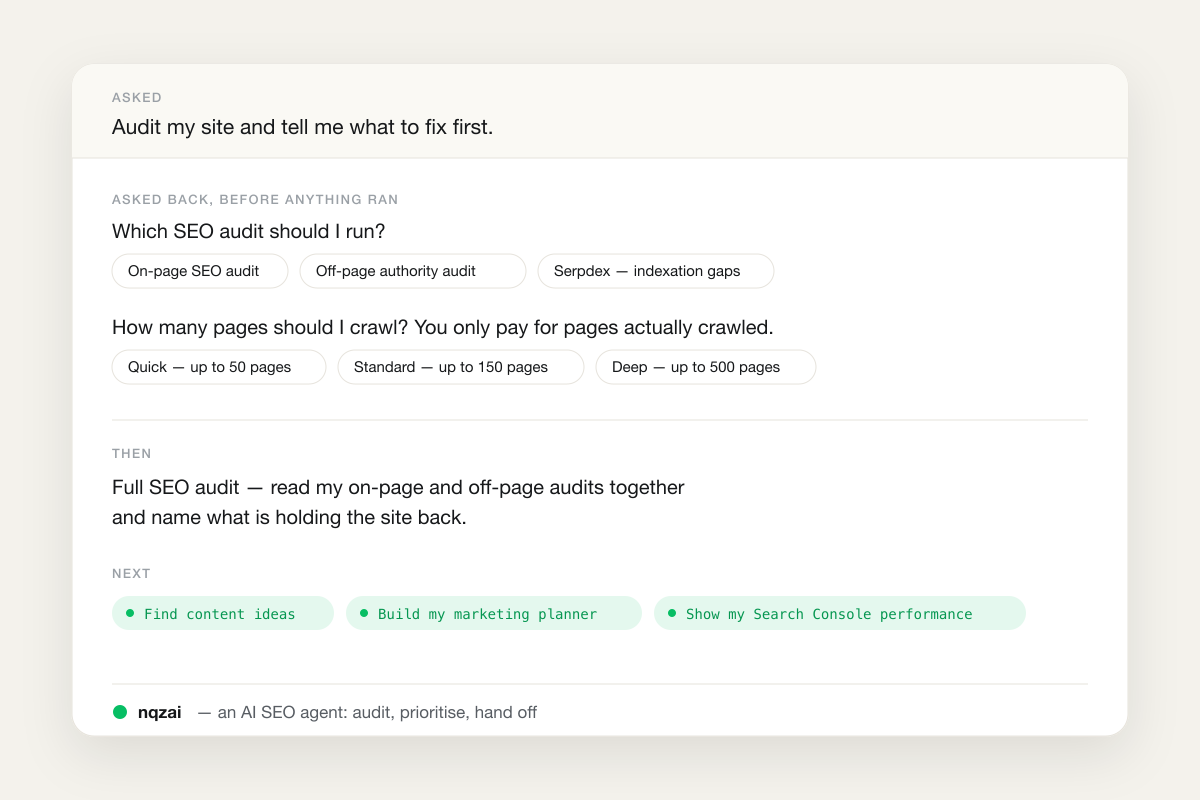
- Which audit, and how deep. The crawl asks how many pages — 50, 150, 500 — with the token price on each option, and you only pay for pages actually crawled.
- An approval card for the expensive runs. On the default setting, an off-page authority audit, a competitor keyword gap or an indexation check stops on a card showing its token estimate until you confirm.
- “You already checked this.” If you ran the same indexation check on the same site within the last 7 days, the card says so above the price, with a chip to see the last results instead.
- Tokens back when a run fails. If every check in a turn errors or comes back empty, the reply carries a button to claim those tokens back.
The same layer runs across the product, not only SEO — see AI agent guardrails for every check it makes before a paid request.
What it will not do
Named plainly, because an SEO agent page that lists only strengths is the thing to be suspicious of.
- It does not edit your existing pages. A new article reaches WordPress or Notion only from the publish button on its card. Submitting pages for indexing is billed per URL and cannot be recalled once sent, so on the default approval setting it stops on a card first.
- It does not promise rankings or indexing. A submitted URL is not an indexed URL, and a fixed issue is not a ranking. It reports what it measured.
- It cannot see your traffic until you connect it. Without Search Console or Analytics, a fault cannot be weighed by the visits behind the page, and the audit says so rather than guessing.
- It does not replace judgement about your market. It sizes and ranks what it can measure; which market is yours, and which trade-off to take, stays your call.
How it compares
| Option | Runs the checks | Reads your Search Console | Says what to fix first | Does the follow-up work | How you pay |
|---|---|---|---|---|---|
| nqzai AI SEO agent | Yes — crawl, authority, indexation and keyword research from one chat | Yes, read-only, when you connect it | Yes — the main constraint, plus what it could not measure | Briefs, articles and a plan; publish to WordPress or Notion from the card | Pay-as-you-go tokens, 1M included on signup |
| Classic SEO suites | Yes — you open each tool and run it | Varies by suite | Issue lists sorted by severity; the triage is yours | Separate tools, or none | Monthly subscription tiers |
| General AI chat assistants | Read pages on request; keep no crawl history of your site | Not by default | From whatever evidence you paste in | Draft text you copy out | Free tier or monthly subscription |
| SEO agency | People run them | With access you grant | Yes, with human judgement | Yes, as scoped in the contract | Monthly retainer |
nqzai’s row reflects the product’s own behaviour as of October 2026. The other rows describe each category in general; check any specific vendor against its current documentation. For agency pricing, see what an SEO company costs.
What each step costs
Every figure below is read from the same billing table the approval card uses, at the time this page is served, and converted to dollars at the retail token rate. Nothing is a subscription.
| Step | Tokens (USD equivalent) | What you get |
|---|---|---|
| On-page crawl, 50 / 150 / 500 pages | 25K / 75K / 250K tokens (~$0.05 / $0.15 / $0.50) | You pick the depth from three chips; you only pay for pages actually crawled. |
| Off-page authority audit | ~340K tokens (~$0.68) | Backlink profile, referring domains, authority and the keywords you rank for, in one report. |
| Full SEO audit (reads across what is on file) | ~25K tokens (~$0.05) | Calls no data provider; it reasons over the measurements already stored for the site. |
| Keyword gap against one competitor | up to ~95K tokens (~$0.19) | Uses a paid keyword-gap source when configured, otherwise a search fallback at no extra cost. |
| Content brief | ~54K tokens (~$0.11) | Outline, angle and structure for one primary keyword. |
| Article draft | ~29K tokens (~$0.06) | A new piece for a keyword, or a rewrite of an existing page. |
| Marketing plan | 28K–46K tokens (~$0.06–$0.09) | No paid provider runs while planning; each initiative is priced when it runs. |
| Why-questions from data on file | No extra cost beyond the chat turn | Answers from stored measurements and names what has never been measured. |
These are estimates; the approval card or picker in the chat shows the exact figure for your request. In the product, costs are shown in tokens only; the dollar figure here is an equivalent for comparison.
Reports tell you what happened. Ask nqzai why.
An SEO agent earns its name on the why-questions. Reports say what happened; ask nqzai why, and it reads the measurements already on file before it reaches for a paid check.
The report is still produced and saved — it rides along as the evidence for the answer, instead of being handed over in place of one. You can open it, copy it, or push it to your CMS. You just don’t have to read it to find out what changed.
SEO agent playbooks
Eight working guides on running an SEO agent well — what to hand it, what to keep, and how to measure it without promising rankings:
- What an SEO agent can do — what it can audit, prioritise and hand off
- SEO agent workflow: audit to action — a weekly loop with a human approval step
- SEO agent data sources — which inputs make recommendations worth acting on
- SEO agent setup checklist for small teams — an implementation checklist sized for a small team
- SEO agent governance — permissions, review and who is accountable
- SEO agent vs SEO tools — where human review still belongs
- SEO agent vs SEO agency — automation, expertise, or both
- SEO agent ROI — measuring productivity without promising rankings
Each step above also has its own page: the SEO audit tool, the indexation checker, AI keyword research, competitor research, why organic traffic drops, content optimization and the AI marketing planner.
Ask it what to fix first
Describe the outcome in a sentence. The agent picks the checks, asks before the expensive ones, and keeps each report as the evidence behind its answer.
For questions beyond your own site — a competitor’s page, a market, a pricing check — the same agent researches the open web: see the AI research agent. New here? How nqzai works covers the chat, the token model and what runs where.
Frequently asked questions
What is an SEO agent?
An SEO agent is software that takes an SEO goal in plain language, decides which checks would settle it, runs them, reads the results and comes back with a next step. The difference from an SEO tool is who drives: with a tool you open each report and do the triage yourself; an agent chooses the checks, joins the results and tells you what it would do first. A good one also tells you what it could not check.
What can nqzai's AI SEO agent actually do?
It crawls your site for on-page issues, audits your backlink profile, authority and ranking keywords, compares Google's index against your sitemap and robots.txt, researches keywords and competitor keyword gaps, and answers why-questions from the measurements already on file. A full SEO audit then reads 6 sources together, names the main constraint and lists what it could not measure. From there it writes content briefs and articles and builds a marketing plan of up to seven initiatives.
What is the difference between an SEO agent and an SEO tool?
A tool answers the question you knew to ask; an agent works out which questions to ask. Most SEO tools hand you a list of issues sorted by severity and stop. nqzai runs the audits you choose, reads them together with your Search Console data when you connect it, and answers with priorities, keeping the report as the evidence behind the answer.
Can an AI SEO agent replace an SEO agency?
Not entirely, and it should not pretend to. An agent takes over the repeatable work: crawls, rank and authority checks, keyword research, first drafts and the weekly re-check. An agency brings judgement about your market, relationships for earning links, and accountability for strategy. Many teams use both: the agent for the measurement and drafting, people for the decisions.
Will it change my website without asking?
No. It does not edit your existing pages. Publishing a new article to WordPress or Notion happens from a button on the article card, and a keyword joins the weekly rank scan only when you click the confirm chip. Submitting pages for indexing is billed per URL and cannot be withdrawn once sent, so on the default approval setting it stops on an approval card first.
Does it need access to my Search Console or Analytics?
No. Audits and keyword research run without any connection. Connecting Search Console and Google Analytics is optional and read-only; it adds real impressions, clicks and sessions, which is what lets it answer "why is my traffic down" and weigh a fault by the traffic behind the page.
What does it cost?
Pay-as-you-go tokens, with no subscription. A 50-page crawl is about 25K tokens, an off-page authority audit about 340K, and the full audit that reads across them about 25K. Why-questions answered from data already on file cost nothing beyond the chat turn. New accounts include 1 million tokens.
Does it guarantee rankings?
No, and you should be wary of any SEO agent that does. It can tell you what is measurably wrong, what competitors rank for that you do not, and which pages are not indexed. Submitting a page for indexing is not the same as it being indexed, and fixing an issue is not the same as ranking. It reports what it measured and what it could not.